
- 2.1: Databases
- 2.2: active Menuitem GoogleMaps
- 2.3: Virtual tours (Web 3D)
- 2.4: Thematic maps
- 2.5: Specialised scientific information
- 2.6: Special applications
Maps generated with Google Maps
Present your geographic data on the internet
Commonly, geographic data are being collected in geo- and biosciences. These coordinates can be presented on maps on the internet.
But data that have relevance for certain localities and for which an interpretation on the internet can be interesting for many users are not limited to geo- and biosciences. Social sciences my analyse the distribution of certain parts of the population, medical sciences the distribution of illnesses, and the location of important buildings may be of interest in architecture or landscaping. Anything that can be shown on maps can be presented dynamically on the internet.
Google-Maps-Api
Most internet users are aware of mapping applications by Google through the desktop application “Google Earth” or the website service for address searches. Google offers to use these functions in other internet applications and offers an application programming interface - API.
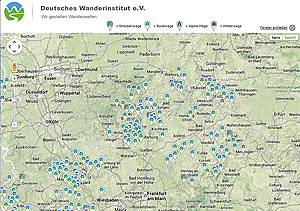
This service is free of charge within certain terms of service (e.g., no commercial use, no excessive use of googles bandwidth). Generally, scientific websites fulfil these terms of service and google maps can be incorporated in scientific websites: dot points (localities) can be presented on both street maps and satellite maps, addresses can be searched for and additional applications can be accessed by mouse-click.
For example: www.ffh-gebiete.de
Die website of "FFH-Gebiete" (FFH-areas; protected fauna and flora habitats in Germany) illustrates the use of Google-Maps-Api. The website presents areas and species of internationally protected areas within the Natura 2000 system of the European Union. The website is based on a database that contains basic data of FFH-areas in Germany (source: Bundeasamt für Naturschutz 2008).
In addition to basic information for each area, the detailed locality of each protected area is presented in both general and more detailed maps.
For mapping the areas their latitude and longitude are accessed from the database. A change between different type of maps enhanced the appearance of the presentation.
The base map is officially offered by Google, so a problematic use of copyrighted maps is avoided.

